Appearance
Custom Templates
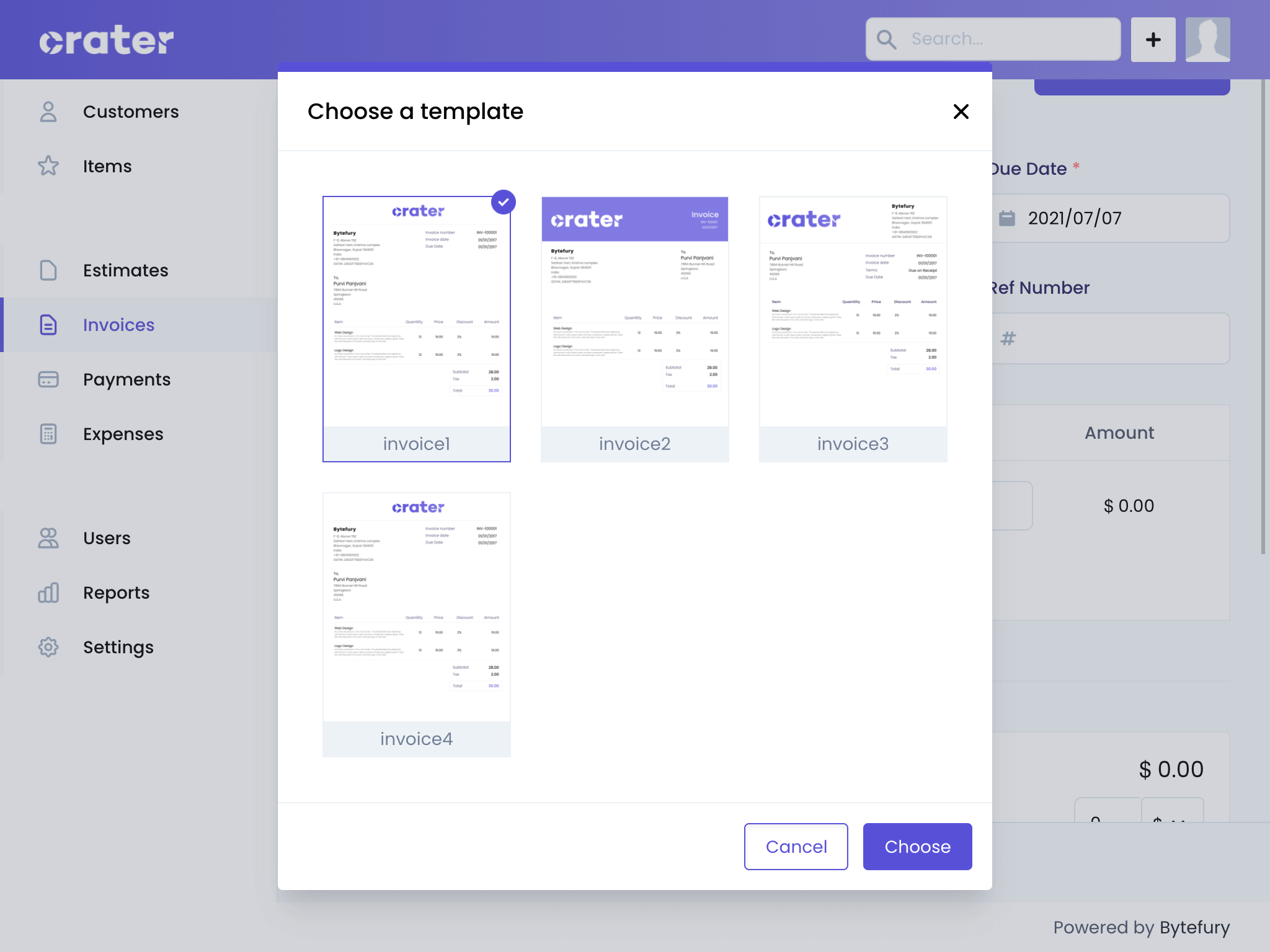
InvoiceShelf ships three invoice designs and three estimate designs. You can add your own, and they appear alongside the built-in ones in the Choose a Template dialog.
Custom templates live outside the application code, so they survive upgrades and Docker image rebuilds:
bash
storage/app/templates/pdf/{invoice|estimate}/{template_name}.blade.phpNote the app/ segment
Earlier versions of this page documented storage/templates/pdf/. That path does not work: a template placed there is never found. The correct location is storage/app/templates/pdf/.
Creating a template
With make:template
bash
php artisan make:template your-template-nameUnder Docker:
bash
docker compose exec invoiceshelf php artisan make:template your-template-nameThe command clones the first built-in design of the type you choose, rewrites its includes to point at your copy, and writes a preview image. Edit the resulting file to taste.
Pass --type to skip the prompt:
bash
php artisan make:template your-template-name --type=estimateBy hand
Create a .blade.php file in the directory for its type:
- Invoices:
storage/app/templates/pdf/invoice/ - Estimates:
storage/app/templates/pdf/estimate/
Any .blade.php file in those directories is picked up automatically and offered in the Choose a Template dialog.
Add a .png alongside it with the same name to give it a thumbnail there. Without one the tile renders blank, so it is worth adding even if you just copy the built-in preview.
What a template receives
Each template is rendered with the document's data already shared into the view. Invoices and estimates get $invoice (or $estimate), $customFields, $company_address, $shipping_address, $billing_address, $notes, $logo and $taxes.
The quickest way to iterate is the ?preview query parameter on the document's PDF URL, which renders the template as plain HTML in the browser instead of a PDF:
/invoices/pdf/{hash}?preview=trueThe shared line-items table
The built-in designs pull their line-items table from a partial, and a cloned template includes it too:
blade
@include('pdf_templates::invoice.partials.table')One table, shared by all your custom templates
That partial is written once, the first time you create a custom template of a type, and every later one of that type includes the same file. Editing storage/app/templates/pdf/invoice/partials/table.blade.php changes the table for all your custom invoice templates, not just the one you are working on.
If you need different tables, point each template at its own copy: create a second file next to it and change that template's @include to match.
Fonts
Templates get their @font-face rules from the packages installed under Settings → Font Packages, via a shared partial:
blade
@include("app.pdf.partials.fonts")Keep that include unless you are supplying fonts yourself. Without it the document falls back to the driver's default font, which for documents mixing writing systems is usually not what you want.
Choosing a design per document
The template is stored on each invoice and estimate, so different documents can use different designs. Ticking Set as default in the picker remembers your choice for the documents you create from then on.